


When learning about coffee origins, Ethiopia often captures the imagination. It is the birthplace of coffee, where smallholder farmers cultivate coffee in forests and mountains much as it has grown for centuries.
Brazil could not be more different.
If Ethiopia represents the origins of coffee, Brazil represents its industrial scale.
Today Brazil is the largest coffee producer in the world, responsible for roughly a third of global coffee production.
That scale means something very important for the coffee industry: Brazil heavily influences global coffee prices. When Brazil has a strong harvest, prices often fall. When crops are damaged by frost or drought, the entire market reacts.
In many ways, Brazil is the country that keeps the world’s coffee supply moving.
How Coffee Arrived in Brazil
Coffee is not native to Brazil.
The plant was introduced in 1727, reportedly smuggled from French Guiana by a Portuguese officer who managed to obtain coffee seedlings despite export restrictions.
At first, coffee was grown only on a small scale.
But by the mid-19th century Brazil had discovered something powerful: the country’s climate, vast land availability and labour systems allowed coffee to be produced at unprecedented scale. By the 1850s Brazil was producing roughly half of the world’s coffee, turning coffee into the backbone of the country’s economy.
The “coffee cycle” shaped Brazil’s infrastructure, politics and culture. Railways were built to transport coffee to ports, entire regions developed around coffee production, and the industry helped drive Brazil’s economic growth for decades.
Even today, coffee remains deeply embedded in Brazilian identity.
Farming Coffee at Scale
One of the most striking differences between Brazil and many other coffee origins is the size of the farms.
While Ethiopian farmers often manage small plots, Brazilian farms can span hundreds or even thousands of hectares.
Large farms mean something else as well: mechanisation.
In many Brazilian regions the terrain is relatively flat, which allows coffee to be harvested using large mechanical harvesters. These machines shake coffee trees and collect cherries in enormous volumes.
This type of harvesting would be impossible in many mountainous coffee regions around the world.
Brazil’s landscape and scale allow it to produce coffee more efficiently than almost any other country.
Why Brazil Loves Natural Processing
Another defining feature of Brazilian coffee is its processing.
While many coffee-producing countries rely heavily on washed processing, Brazil is famous for natural and pulped-natural coffees.
The reason is surprisingly simple: climate.
Brazil’s coffee regions benefit from consistent sunshine and well-defined seasons. The dry winter period coincides with harvest season, allowing coffee cherries to dry naturally on large patios without the risk of constant rain.
Because of this, the natural process became the dominant method in Brazil.
In natural processing, the entire coffee cherry is dried before the fruit is removed from the bean. This often creates sweet, full-bodied coffees with notes of chocolate, nuts and caramel.
Why Brazilian Naturals Taste Different
Natural coffees from other origins can sometimes taste intensely fruity or “funky”.
Brazilian naturals, however, are usually more balanced and approachable.
There are a few reasons for this:
- lower average growing altitudes
- different varieties
- controlled drying environments
- large-scale harvesting methods
Together these factors often produce coffees that are sweet, chocolatey and low in acidity, rather than extremely fruity or ferment-forward.
That flavour profile is one of the reasons Brazilian coffee is so widely used in espresso.
Coffee Varieties in Brazil
Brazil grows a wide range of coffee varieties, many of which were developed specifically to thrive in the country’s conditions.
Common varieties include:
- Bourbon
- Mundo Novo
- Catuai (Red and Yellow)
- Catucai
- Topázio
Brazil has also played a significant role in coffee research and breeding, developing cultivars designed to improve productivity, resilience and cup quality.
The Backbone of Espresso Blends
Because Brazil produces coffee at such scale, it plays an important role in roasting as well.
For many roasteries, Brazilian coffee forms the foundation of espresso blends.
There are several reasons for this:
- reliable supply
- consistent flavour profile
- approachable taste
- strong body and sweetness
- relatively stable pricing
These qualities make Brazilian coffees excellent base components for blends that require both consistency and volume.
In fact, Brazil plays this role in our own roasting programme.
Our Top Dog espresso blend uses Brazilian coffee as one of its core components, bringing sweetness, body and balance to the cup.
Visiting Fortaleza Farm
Brazil is also where we sourced one of our favourite single origins.
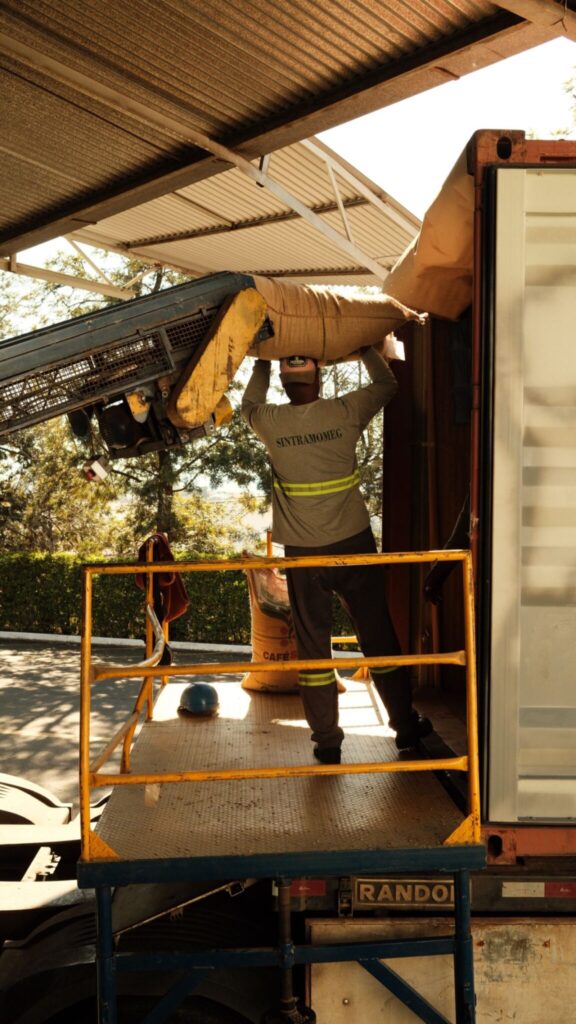
Our Brazilian coffee from Fortaleza Farm is a coffee we had the opportunity to visit ourselves. Seeing coffee production at that scale offers a completely different perspective on how diverse the coffee world really is.
From large drying patios to mechanical harvesters and vast landscapes of coffee trees, Brazil shows just how sophisticated modern coffee farming can be.
Brazil’s Global Coffee Identity
Brazil has also invested heavily in promoting its coffee internationally through initiatives like “Coffee of Brazil”, a programme designed to showcase the diversity and quality of Brazilian coffee to the global market.
For many years Brazilian coffee was often associated purely with commodity production.
Today that perception is changing.
Producers across Brazil are increasingly investing in specialty coffee, improving processing techniques, experimenting with varieties and showcasing the potential of their terroirs.
A Different Side of Coffee
If Ethiopia shows us where coffee began, Brazil shows us how coffee became a global industry.
The two origins could not look more different.
One represents the birthplace of coffee and smallholder tradition.
The other represents scale, innovation and the systems that allow the world to drink coffee every day.
Both are essential to the story of coffee.
Are you interested in our Caffeine Academy, stocking our coffees or anything else? Reach out to our team here.